If someone calls you ugly, does that make you ugly? If someone calls you stupid, or annoying, does it become true?
Most of us would say no. Other people's words are usually their perception, or their projection, rather than a fact about us. But there's a trickier question: if someone tells you you're amazing, do you automatically believe it?
Often we don't. That suggests the words that shape us most aren't the ones we hear from others. They're the ones we say to ourselves.
The voice you hear every day
There is one person you listen to from the moment you wake up: you. Think about what that voice said to you today.
"I'm not good at my job." "I'm too shy." "Nobody likes me." Or perhaps: "I can learn." "I am worthy." "I'm doing okay."
Were those words kind, neutral, or unkind? Most of us have never stopped to check.
The iceberg inside your mind
Your conscious mind is the part you're aware of right now. It's what you use to read this sentence, decide what to eat, solve a problem, or replay yesterday's conversation. You can feel yourself choosing.
But what happens when you do something so many times that you stop thinking about it? Brushing your teeth, riding a bike, tying your shoes, typing. These move out of conscious effort and become automatic.
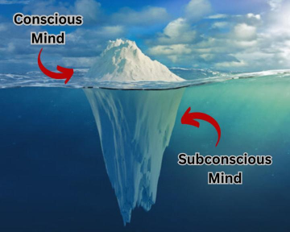
Think of an iceberg. The small tip above the water is your conscious mind: "I am thinking about this right now." Below the surface is a much larger mass of subconscious patterns: things you've learned, repeated, experienced, and come to believe. You can't see all of it, but it still influences what happens above the water.

How a belief gets there
Beliefs rarely arrive all at once. They tend to follow a path:
Hear it → Repeat it → Believe it → Act from it
Imagine a child who repeatedly hears, "You're terrible at sports." At first it's just something someone said. Then it becomes "Maybe I'm bad at sports." Later it hardens into "I'm just not sporty." Eventually, when it's time to play, the thought is "I'm not even going to try."
Did that person become bad at sports, or did they start acting from a belief? And this isn't only about children. Adults carry these inherited scripts into careers, relationships, and dreams they've quietly decided aren't for them.
Not everything people say becomes a belief, though. If I tell you you're a purple elephant, you won't believe me. Our minds don't accept everything. But messages that are repeated, especially from people we trust or from ourselves, can sink in.
Be a belief detective
When you catch a belief like "I'm not smart," ask where it came from:
• Did someone say it?
• Did I fail at something?
• Did I compare myself to someone else?
• Did someone laugh at me?
• Did I just keep telling myself?
Then ask the most useful question: is this a fact or a story?
A fact describes something that happened. A belief is the meaning we attach to it. For example:
|
Fact |
Story |
|
"I got 40% on the test." |
"I'm stupid." |
|
"I made a mistake." |
"I always mess everything up." |
|
"She didn't invite me." |
"Nobody likes me." |
The facts may sting, but they're survivable. The stories are what quietly rewrite our identity.
You can make a mistake without becoming a mistake
Your mistakes are things you do. Your identity is who you are.
If you fail a test, are you a failure? If you lose a race, are you a loser? If you make a bad choice, are you a bad person? No, no, and no.
I can make a mistake without becoming a mistake.
If you take only one idea from this post, make it that one.
The brain loves repetition
Hear a song twenty times and you'll know the words. Repetition is how we learn, and that includes what we repeatedly think and say about ourselves. So we can practice replacing:
• "I'm terrible at everything" → "I am learning."
• "Nobody likes me" → "I am worthy of friendship and connection."
• "I'm ugly" → "My body deserves love and respect."
• "I'm stupid" → "I may not know it yet, but I can learn."
Affirmations aren't magic
Say "I can fly" a hundred times and you won't grow wings. Affirmations aren't spells, and the goal isn't to pretend something is true. The goal is to train ourselves to speak about ourselves in healthier, more truthful ways.
The difference between a helpful and an unhelpful affirmation is whether you can actually believe it:
|
Unhelpful |
Helpful |
|
"I am perfect." / "I don't make mistakes." |
"I am allowed to make mistakes and learn from them." |
|
"Everyone loves me." |
"I don't need everyone to like me to know I have worth." |
|
"I am never afraid." |
"I can feel afraid and still be brave." |
|
"I'm the most beautiful person in the world." |
"I appreciate and respect my body." |
What self-love is and isn't
Self-love is not thinking you're better than everyone, never making mistakes, always feeling confident, never getting angry, needing everyone's approval, or pretending everything is fine.
It means treating yourself with kindness. It means accepting that you're still learning, recognizing your mistakes without attacking yourself, feeling difficult emotions without judging them, knowing your worth doesn't vanish when you struggle, and growing without hating who you are today.
Consider Amina, who gets irritated easily. One day she says, "I hate myself when I get angry. I'm a horrible person." What's wrong with that? Her anger is an emotion. Her behaviour is something she can learn to manage. Neither one determines her worth. A kinder, more accurate version might be: "Sometimes I get angry quickly. I can learn how to respond differently."
The pause button
Between a trigger and your reaction, there's a gap. You can use it with three steps: notice, breathe, choose.
Say someone tells you, "You're so annoying!" The automatic reactions are anger, hurt, hitting back, walking away, or tears. But you can pause and ask: is that a fact, or is it their opinion or projection? You can use the same pause before you believe a thought, before you say something, and before you act.
Try this: the inner voice challenge
Imagine your thoughts were played through a speaker all day. Would you want everyone to hear how you talk to yourself? If not, change the voice. Not into fake positivity, but into language that is kind, truthful, and empowering.
Try rewriting a few:
• "I'm ugly." → "My appearance does not determine my worth."
• "I'm bad at maths." → "Maths is challenging for me right now, but I can learn."
• "I'm too emotional." → "My emotions are information. I can learn to understand and regulate them."
• "I'm not good enough." → "I don't have to be perfect to have worth."
• "Everyone is better than me." → "Someone else's strengths do not take away from mine."
Then finish a few of these sentences for yourself: I am… I deserve… I am learning to… When I make a mistake, I can… I don't have to be ______ to be worthy. One thing I love about myself is…
The identity equation
What I repeatedly think + what I repeatedly say + what I repeatedly do = patterns I practice
And the patterns you practice can shape how you see yourself. The good news is that you aren't stuck. The brain can learn new patterns.
A closing practice
Stand up if you can. Put one hand on your heart and one on your stomach. Take one slow breath, then say, slowly:
I am worthy. I am still learning. I can make mistakes and still love myself. My emotions do not make me bad. Other people's opinions do not define me. I can choose what I believe about myself. I am becoming someone I am proud to be.
Then ask yourself: what is one thing I'll say differently to myself this week?
And finally, the question this whole post comes back to: who are you going to practice being? Not who everyone else says you are, or who social media says you should be, or who your mistakes say you are, but who you choose to become.