Every day, children absorb messages about who they are. Classmates comment on how they look. Social media shows them who they are “supposed” to be. Adults, often with the best intentions, correct and compare. And underneath it all runs the loudest voice of all: the one inside their own head.
Lifeskills Academy exists to help children notice that inner voice, question it, and shape it with kindness and truth. This page explains who we are, what we teach, and what a class looks like, so you can decide whether it is the right fit for your family.
What Lifeskills Academy Is
Lifeskills Academy is a life skills program for children aged 9 to 16. Instead of focusing only on outer skills, we teach the inner ones: self-love, self-worth, self-esteem, authenticity, emotional awareness, non-judgment, and belief in oneself. These are the skills that decide how a child handles criticism, failure, comparison and pressure, now and as an adult.
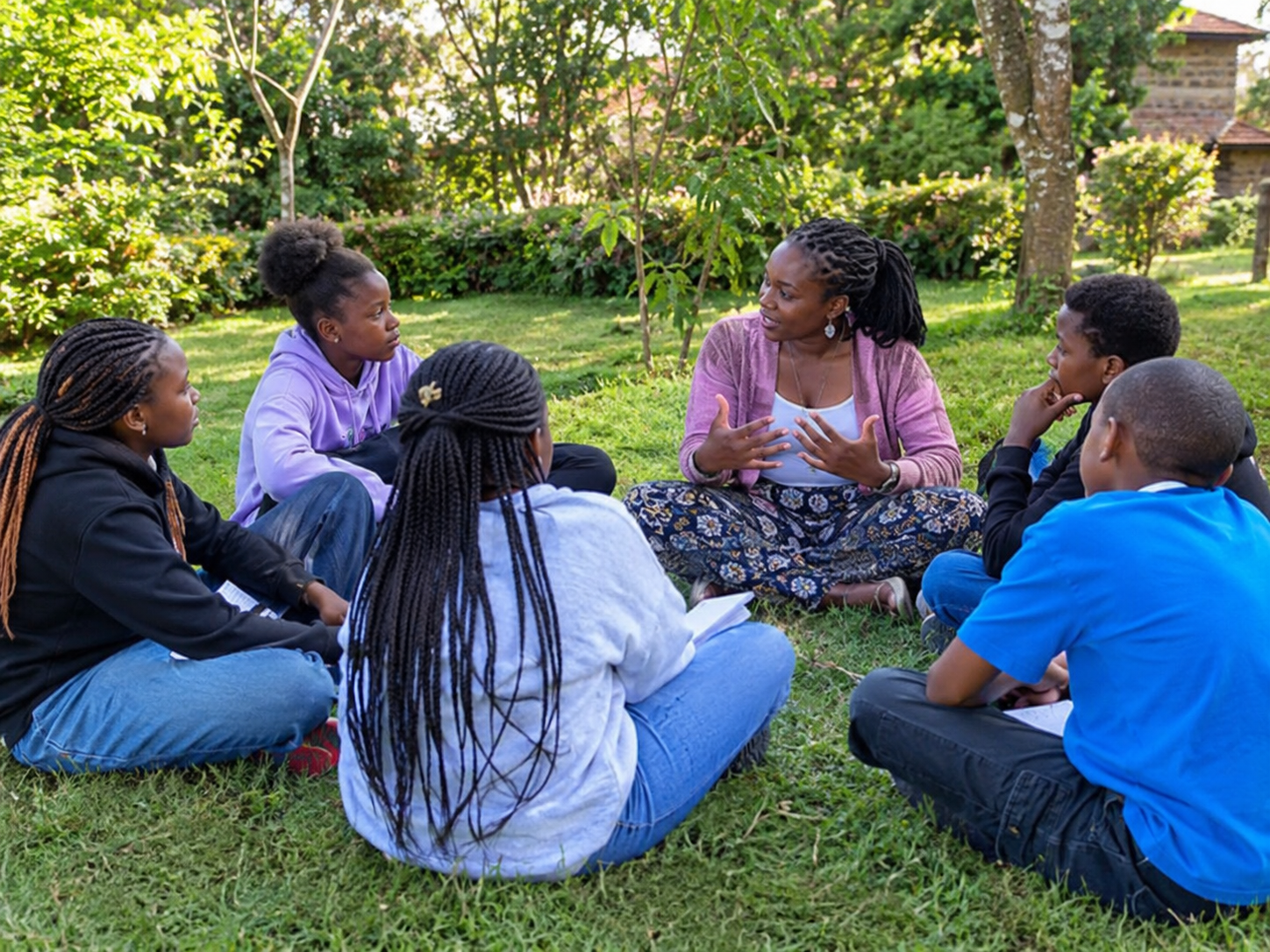
We run live online classes, and in-person community programs in our area. Groups are kept small so every child is seen and heard.
This Is Not a Program for “Fixing” Children
Children do not join us because something is wrong with them. They join because their parents want to give them a strong foundation early, in the same way you would choose good nutrition before a deficiency appears. Our work is about prevention and preparation: helping children build a sense of self that is steady enough to withstand whatever the world says to them.
Our Approach: Learn, Reprogram, Embody
Most children are told what to think about themselves. We help them understand how those thoughts form, and how to change them. Every lesson moves through three stages.
• Learn. Simple explanations, stories and discussion help children understand an idea, such as how beliefs form or why other people’s words are not automatically true.
• Reprogram. Through reframing, repetition and honest affirmations, children practice new, healthier ways of thinking and speaking about themselves.
• Embody. Knowing something in the head is different from living it. Breathing exercises, role-play, drama, mirror work and movement help children feel the lesson in their bodies and rehearse it in real situations.
One principle runs through everything we teach: in our classroom there are no mistakes or failures, only lessons.
What Children Learn
1. Loving Yourself Unconditionally
Self-love is not arrogance. It does not mean thinking you are better than everyone, never making mistakes, or always feeling happy. It means treating yourself with kindness, admitting you are still learning, and knowing your worth does not disappear when you struggle.
Children learn to accept every part of themselves, including the parts they may have been told are “too much”: a quick temper, a loud laugh, a shy nature. In one lesson we meet Amina, who gets irritated easily and says, “I hate myself when I get angry.” Children discuss what is wrong with that sentence and discover that her anger is an emotion, her behaviour is something she can learn to manage, and neither one decides her worth.
2. Worth Is Not Earned
Many children quietly believe they must earn their value through grades, looks, talent or popularity. We teach the opposite: worth is already there. Our lessons are grounded in the belief that every child is created with inherent worth and purpose.
The anchor phrase for our whole curriculum is this: I can make a mistake without becoming a mistake. Children learn to separate what they do from who they are. Failing a test does not make a child a failure, and a bad choice does not make a child a bad person.
3. Uniqueness and Non-Judgment
In our first class, children examine their own fingerprints and learn that no two are alike. It is a simple, memorable picture of the idea that each of us is one of a kind. From there we explore non-judgment: people who look, sound or act differently are part of the same human family, and difference is nothing to be mocked or feared.
We also turn this lens inward. A child who judges others harshly often judges themselves just as harshly, so practising kindness in both directions is part of the same skill.
4. Loving the Body We Have
Children in this age group are often highly critical of how they look. We shift the focus from how the body looks to what it does. Through gratitude exercises, letter-writing to different body parts, and daily mirror practice, children learn to speak to and about their bodies with respect.
The aim is not to convince a child they must love every feature at once. It is to replace automatic criticism with appreciation, one small step at a time.
5. What Other People Say About Us
We ask a simple question: if someone says you are ugly, does that make you ugly? Children quickly see that it does not. What others say about us reflects their perception, their mood, and sometimes their own insecurities. We call this projection. It is not automatically true about us. It only becomes part of our story if we begin to believe it.
Children learn practical tools for these moments:
• The ball you do not have to catch. Words can be thrown at you, but you can let them fall.
• The pause button: Notice, Breathe, Choose. Before reacting, a child pauses, takes a breath, and chooses how to respond.
• The fact-or-story check. Is this a fact, or is it someone’s opinion or projection?
This is not about becoming cold or ignoring feelings. It is about responding calmly, without losing a sense of self.
6. How the Mind Works: Conscious and Subconscious
We teach children about two parts of the mind. The conscious mind is the part they are aware of right now: listening, deciding, solving problems. The subconscious holds the patterns we have learned through repetition, like brushing teeth, riding a bicycle or tying shoes, things we do without thinking.
Beliefs form in much the same way. We hear something, we repeat it, we begin to believe it, and then we act from it. A child who is repeatedly told they are bad at sports may begin to think, “I’m just not sporty,” and then stop trying. Did they become bad at sports, or did they start acting from a belief?
In the “Belief Detective” activity, children learn to tell facts from stories. “I got 40% on the test” is a fact. “I’m stupid” is a story. A fact describes what happened. A belief is what we decide it means about us. And the most hopeful part of the lesson: the brain can learn new patterns, so no one is stuck.
7. Reprogramming With Honest Affirmations
Affirmations are not magic spells. Saying “I can fly” a hundred times will not grow wings, and we say so to the children. We practice affirmations that are kind and truthful, because the goal is not to pretend, but to train healthier habits of thought.
Children practice turning unhelpful thoughts into honest ones:
• “I’m ugly” becomes “My appearance does not determine my worth.”
• “I’m bad at maths” becomes “Maths is challenging for me right now, but I can learn.”
• “I’m not good enough” becomes “I don’t have to be perfect to have worth.”
• “Everyone is better than me” becomes “Someone else’s strengths do not take away from mine.”
They also learn to spot unhelpful affirmations, such as “I never make mistakes,” and replace them with ones they can truly believe, such as “I am allowed to make mistakes and learn from them.”
8. Emotional Awareness and Regulation
Emotions are information, not enemies. Children learn to name what they feel, notice where it shows up in the body, and use breathing to settle. A feeling like anger or sadness does not make a child bad. It is a signal to understand and, over time, a skill to manage.
9. Not Needing Applause
Encouragement is lovely, but a child whose sense of worth depends on it is always at the mercy of other people’s reactions. Through stories and role-play, children practice asking, “Did that feel true and good to me?” and discover that their own approval can be the foundation, with others’ praise as a welcome extra.
10. Trusting Yourself and Choosing Who to Become
Our closing challenge for many lessons is one question: who are you going to practice being? Not who everyone else says you are, not who social media says you should be, and not who your mistakes say you are, but who you choose to become.
A Look Inside a Class
A typical class follows a gentle, predictable rhythm so children feel safe:
1. Opening affirmation said together as a group
2. Welcome and check-in
3. A warm-up game to bring energy and connection
4. The lesson, usually through a story, a question or a short discussion
5. An activity: role-play, writing, drawing, mirror practice or a group exercise
6. Reflection, where sharing is invited and never forced
7. Closing ritual, often with one hand on the heart, one slow breath, and a few affirmations spoken together
A Sample Lesson: “Who Is in Charge of the Story I Believe About Myself?”
This lesson begins with questions: does something become true just because someone says it? Children then notice the other voice they hear every day, their own, and sort the things they say to themselves into kind, neutral and unkind. A short game introduces the conscious mind, then we explore how repeated messages become beliefs, and use the fact-or-story check on real examples.
We close on our feet, hand on heart, repeating together: I am worthy. I am still learning. I can make mistakes and still love myself. My emotions do not make me bad. Other people’s opinions do not define me. I can choose what I believe about myself.
How Parents Can Support at Home
You do not need to teach any of this yourself, but small habits at home make a real difference.
• Ask a different question. Instead of “What did you learn?”, try “What is one kind thing you said to yourself this week?”
• Watch your own self-talk. Children absorb how we speak about ourselves.
• Separate behaviour from identity. “That choice wasn’t okay” teaches differently from “You’re bad.”
• Make mistakes normal. Share one of your own and what you learned from it.
• Practise together. One minute of slow breathing or a shared affirmation at bedtime builds the habit.
What We Are Not
• Not therapy. We are a life skills program. If a child needs clinical support, we will gently suggest speaking with a qualified professional.
• Not forced positivity. All feelings are welcome in our classes, including the difficult ones.
• Not about changing your child. We help children understand and accept who they already are.
• Not pressure to share. Children are never made to speak about anything they are not comfortable sharing.
Small Groups and Safe Spaces
Online classes are held in small groups. The class link is shared only with enrolled families, participants are admitted from a waiting room, and sessions are recorded only with written parental consent. In-person classes take place in an open, supervised space, with children signed in and out and a second responsible adult present. We never post children’s full names publicly.
Our Programs
Online classes. Live, once a week for one hour, with the day chosen by the parent. Classes are ongoing, with no fixed end date, and families can pause or stop at any time.
In-person community program. A holiday program for children aged 9 to 16 at [location]. [Add dates and times when finalised.]
For current schedules and fees, please contact us on WhatsApp at [number].
Frequently Asked Questions
What ages do you teach? Children aged 9 to 16, grouped sensibly by age.
Will my child have to share personal things? No. Sharing is invited, never required.
How long does the program run? Online classes are ongoing, and you can continue for as long as it benefits your child.
Is there a trial class? Yes, your child is welcome to try one class before committing.
How do I enroll? Message us on WhatsApp at +254 707272018, and we will guide you through a short registration.
A Final Word
A child who truly values themselves does not need to chase approval, shrink from criticism, or hide the parts of themselves they were taught to be ashamed of. They can make mistakes and keep going. They can hear unkind words and let them fall. That is what we are growing, one honest lesson at a time.
We would love to meet your child. Reach out on WhatsApp at +254 707272018 to ask questions or book a place.