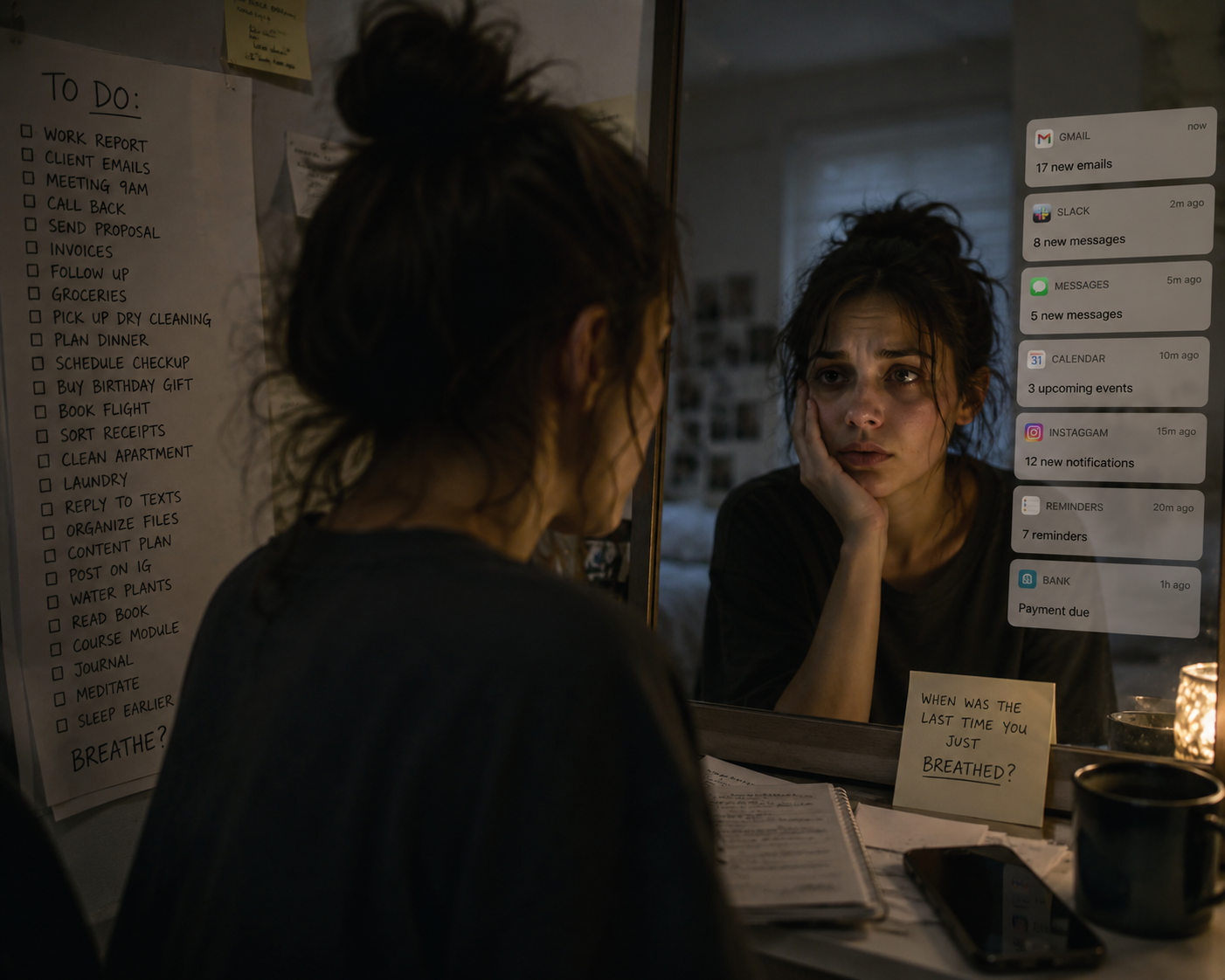
"She stared at the list that never seemed to end, at the notifications piling up like unpaid bills, at the face in the mirror that looked back with tired, searching eyes — and for a long moment, she could not remember the last time she had simply breathed."
If something in that sentence just landed somewhere in your chest, you are not alone, and you are not broken either. That quiet collapse, that happens with a slow, suffocating weight, is something millions of people are carrying right now, in silence, in offices and kitchens and late-night bedrooms across the world. Someone on the internet recently asked a simple question: "When you're feeling overwhelmed at the amount of things you have to get done, what do you do to calm yourself down and get through it?" The response was a flood of story after story of people nodding, sighing, recognizing themselves in each other's words.
A young man in his twenties wrote about losing his father the same week he stepped into his first job, about clearing generational debt while his peers were posting holiday photos, about carrying the weight of a whole family on shoulders that had barely finished growing. A university student wrote about friendships fading, studies slipping, internship rejections piling up which created an exhausting feeling that no matter how hard she tried, nothing was falling into place. And someone else observed, with a kind of weary wisdom, that if everyone seems to be feeling behind, then perhaps no one is truly behind. And yet somehow, knowing that doesn't seem to make the weight any lighter.
Overwhelm is not a personal failure. It is not a sign that you are weak, or that you have somehow gotten life wrong. It is one of the most deeply human experiences there is. It is an inevitable result of being a feeling person in a complex world, with real responsibilities, real losses, and a heart that genuinely cares. The first and most important thing to understand is that what you are feeling is normal, and it is shared by far more people than you will ever see raising their hands to admit it.
The Trap of Pushing Through
Here is something most of us learn the hard way: ignoring overwhelm does not make it go away. It simply changes form. It becomes the low-grade headache that has been with you for three days. It becomes the inexplicable irritability that surfaces at the smallest inconvenience. It becomes the background hum of unease, the unsettling sense that something is wrong, but you cannot quite put your finger on what. The body keeps the score even when the mind refuses to look at the board.
We live in a culture that celebrates pushing through, grinding harder, staying busy. And so when the weight gets heavy, many of us do the only thing we have been taught to do: we add another item to the to-do list, we scroll through distractions, we pour a drink, we throw ourselves into work or exercise or anything that keeps us moving fast enough that we don't have to feel what is sitting beneath the surface. This is understandable, and it is human, but it is also not the way through.
Until you name a thing, it will name you. Until you identify and accept that you are overwhelmed (not as a dramatic confession but as a simple, honest recognition) it will continue to operate quietly in the background of your life, coloring everything without you knowing why. The act of saying, even just to yourself, "I am overwhelmed right now, and here is why," is not defeat but the beginning of movement.
Come Back to the Body
Once you have named what you are carrying, the invitation is not to immediately problem-solve your way out of it. The invitation is to do something that our fast-paced lives rarely allow for: to sit with it. This is the teaching at the heart of somatic healing work. It is the understanding that emotions are not just mental events but physical ones, and that unfelt feelings do not disappear; they simply get stored in the body, becoming tension, fatigue, anxiety, and disconnection over time.
Dr. Sue Morter, whose work in energy medicine and body-centered healing has touched countless lives, teaches that the body is not just a vehicle for the mind but also a doorway into deeper awareness and resolution. When you feel overwhelmed, rather than fighting the feeling or fleeing from it, the practice is to drop your attention gently downward, out of the spinning thoughts in your head and into the physical sensation in your body. Where do you feel the overwhelm? Is it a tightness in your chest, a knot in your stomach, a heaviness in your shoulders? Whatever you find, simply place your awareness there, without trying to change it or explain it away.
Then breathe into that place. Not a forced or performative breath, but a slow, deliberate, gentle breath that travels consciously to that area of the body. When you breathe this way, you are not being passive. Rather, you are actively inviting energy to move through places where it has become stuck. You are telling your nervous system that it is safe to feel, and safe to release. This is not a weakness. This is one of the bravest and most intelligent things a human being can do.
You may feel emotion rise as you do this. Perhaps tears, perhaps a sudden awareness of grief or frustration that you have been carrying for longer than you realized. Let it come. Energy that is allowed to flow will not drown you; it is the energy that is dammed and suppressed that creates the internal floods we call burnout and breakdown.
Breathing Exercise: The Five-Count Reset
When overwhelm is acute and you need to find your way back to the present moment, this simple breathing practice can serve as an anchor.
Find a comfortable seated position and allow your eyes to close or soften their gaze. Begin by simply noticing your breath as it is, without changing anything, for a few moments. Then gently begin to extend your inhale to a count of five, breathing in slowly through your nose, feeling your belly and chest expand. Hold that breath softly at the top for a count of two. Then exhale slowly through your mouth to a count of seven, allowing everything to release with that breath. As you exhale, consciously soften whichever part of your body is holding the most tension. Repeat this cycle at least five times, and as you breathe, imagine the breath travelling directly to the area in your body where you feel the overwhelm most strongly. This is not to fix it, but to meet it with warmth and attention.
Even three minutes of this practice has been shown to shift the nervous system out of the fight-or-flight response and back into a state of regulated, grounded awareness. It is available to you anywhere, at any time, and it costs nothing.
Now You Can Think
There is a saying, often attributed to Albert Einstein, that "no problem can be solved from the same level of consciousness that created it." When you are deep in the grip of overwhelm, your nervous system is operating in survival mode. From that contracted, anxious place, every problem looks larger, and every option looks smaller than it actually is. This is how the human brain works under stress.
But something changes when you have paused, named what you are feeling, breathed into your body, and allowed yourself to arrive in the present moment. The problems have not disappeared, but you have changed in relation to them. From this more grounded place, you can begin to look honestly at what is in front of you, to separate what is urgent from what is merely loud, to identify the one next step that is within your reach rather than trying to solve everything at once.
Sometimes the way forward is practical. Like a conversation that needs to happen, a task that can be delegated, a boundary that needs to be gently drawn. Sometimes it is about perspective, such as recognizing, as that wise voice on the internet observed, that if everyone feels behind, then perhaps the race itself deserves to be questioned. And sometimes the most powerful thing is simply to extend to yourself the same compassion you would offer without hesitation to a friend who came to you exhausted and struggling.
You are allowed to be human. You are allowed to be overwhelmed. And you are always, always allowed to begin again, one breath, one moment, one gentle step at a time.
If this resonated with you, share it with someone who might need to read it today. And if you are in the middle of a heavy season right now, hold on. You are not as alone as it feels. If you need support, MySafespace is always here for you. As always, sending you love!